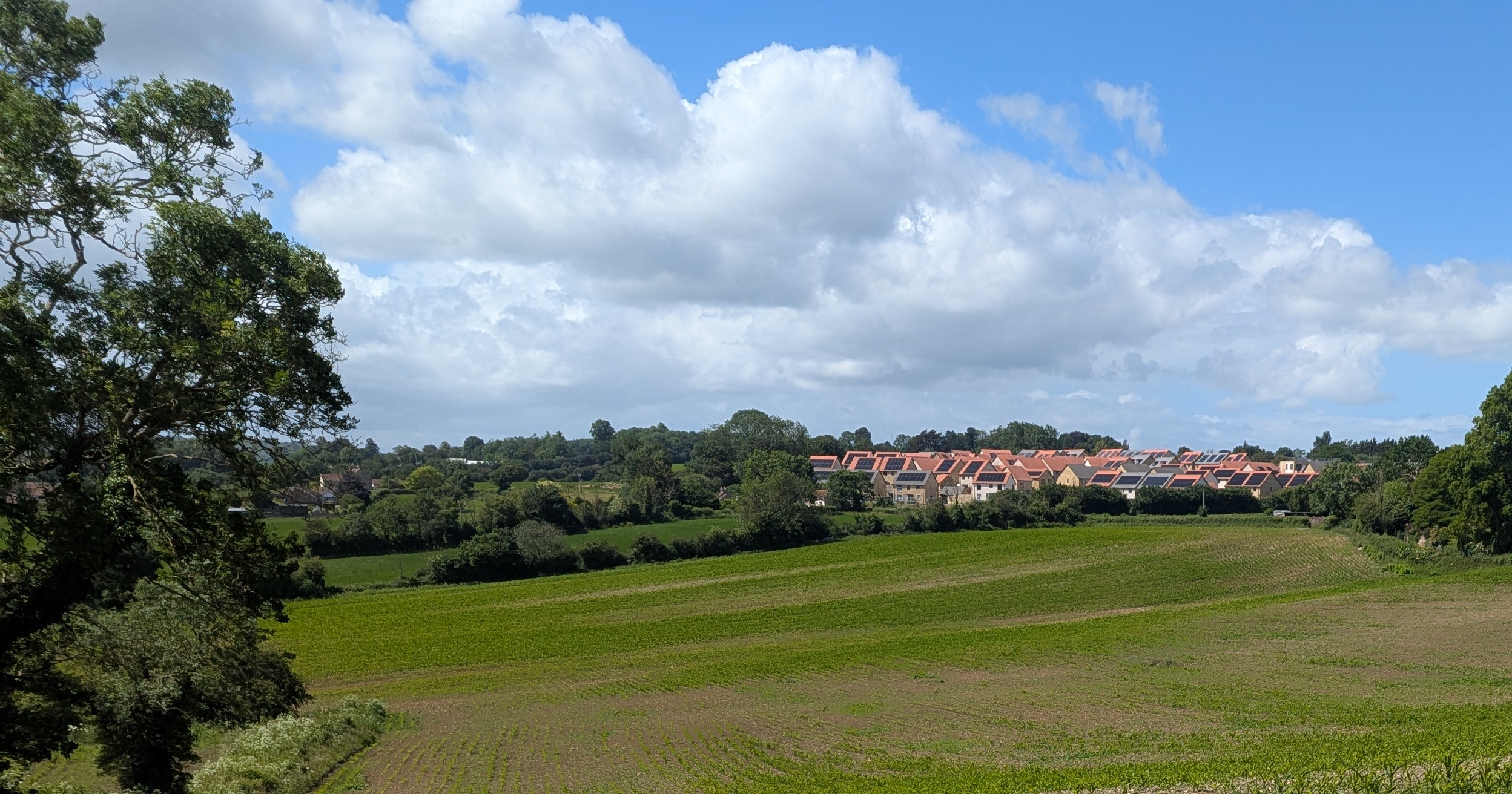
The curious case of the Selwood ‘Garden Community near Frome in Somerset, was that it managed to bypass the whole Local Plan process and obtained direct planning permission from the Secretary of State. This was despite its size (1,700 homes), the adverse impact on the west country landscape, its extremely unpopularity with the town of Frome where several hundred new homes are already in construction on field, and despite ‘minded’ refusal by the local planning authority.
On transport we were amazed, for the Secretary of State decided it was entirely sustainable even though we could hardly think of a more unsustainable location transport-wise and were sure the development would end up almost entirely car-based. See our summary table for our perspective on this.

The planning application for the Selwood Garden Community with thousands of pages on traffic modelling, environmental impact, voted against by the Somerset planning committee in February 2025. The Secretary of State called in the application for his determination only a few days later, and a public inquiry was held in August. In 2026 the development was given outline planning permission.
At the planning inquiry many local people thought that this would at last be their chance to debate with the developer in front of the Inspector using their evidence submitted, explaining why the development was so unpopular including why the Transport Assessment and location were wrong. They imagined that the Inspector would then see there were more sides to the argument and that objectors really had a point.
But of course but it doesn’t work that way. In fact the inquiry was over in just a few days because, although Somerset’s Council planning committee had voted against the development, it decided for the purpose of the inquiry to take a neutral stance. A councillor explained that actively fighting the appeal “could lead to the financial ruin of the council” (see for example the BBC report). The formal legalistic process of a planning inquiry is expensive to participate in. Somerset CPRE, who had had a successful crowd funder to pay for an expert witness on landscape, were in a much better position. The developer’s barrister indeed enjoyed some dramatic moments when he examined the landscape expert in ‘Rumpole of the Bailey’ fashion. This left many of the audience open-mouthed, thankful that they were not in front of a barrister!
By the time of the public inquiry, everyone knew that the government by then was keen on increasing housing numbers at all costs and not at all keen on perceived ‘blockers’ to development. It didn’t bode well.
But how did this bypass the Local Plan?
A good question is how a big development of 1,700 homes can circumnavigate the Local plan when the entire NPPF is ‘plan-led’. The problem is that when Local Plan production is delayed (and this is extremely common) there is then a lack of land earmarked for construction of five years worth of housing target. Developers then have an option. This is to put in for a planning application anyway, and bypass the Plan.

Large developments refused by local authorities without a five year housing land supply are increasingly called in by the Secretary of State. As far as we know however, the Selwood Garden Community is the largest greenfield housing proposal to have successfully got permission by this route. But perhaps this is the way of the future.
Transport

What about Transport? Our position was that the location of the Selwood Garden Community proposal was simply not in a sustainable location in terms of transport. It would be a classic ‘cowpat’ development. For this reason put in a substantial amount of evidence to the planning application and later to the Planning Inspectorate, describing why we thought this. We also took on the notion that the development was ‘vision-led’, a new concept in the NPPF, the National Planning Policy Framework. For a detailed view of the points we made, see our summary table which includes conclusions by the planning Inspectorate and Secretary of State.
We could not afford the cost of ‘Rule 6 status’ to participate properly in the inquiry nor could we afford expert witnesses. But we hoped that our substantial submissions to the planning application and to teh inquiry, especially on vision-led planning and transport might be taken into account. Why did we not succeed?
First because failing to have a five year housing land supply, and a delayed new Local Plan tilt the balance in favour of approval. This is a key part of the NPPF, the National Planning Policy Framework. But also because we like others compiled evidence to show the failings of the Transport Assessment did not have the right status and resources at the inquiry to make headway against the developer’s transport consultant – it’s how a planning inquiry is played.
The lessons learnt from our experience with the Selwood Garden Community includes:
- Fund raise early for expert witnesses with the proper qualifications. There may need to be more than one employed eg on bus, active travel, traffic, density and layout etc.
- Evidence will need to be produced, and again it is best if this is written by well qualified individuals.
- Understand how to use and interpret the language of the NPPF, the National Planning Policy Framework to make your case.
- Register for rule 6 status so that your organisation can see and formally respond to all teh evidence put in by the other side. There will naturally be a great deal of reading involved, and admin in circulating responses, rebuttals etc.
- Have you own legal representative if possible to advise witnesses and respond to the developer’s barrister.
But ultimately, if transport is only a minor player in the game, and the need to build housing eclipses the location and the transport considerations, stopping the continued march of car-based sprawl is far from easy! Our up and coming blog ‘Frome our Wiltshire Correspondent’ looks at some of the results ‘on the ground’.